

His death was almost as poetic as it was sudden. Wagner Group founder Yevgeny Prigozhin met his sudden end in August 2023 when his private jet fell out of the skies over the Tver Oblast of Russia. He had shocked the world only weeks before, when he pulled his soldiers in the Wagner Group off of the frontlines in Ukraine, and ordered their march on Moscow.
For a moment, it seemed like Russia would collapse into chaos. The city of Rostov had been taken by the mutineers, helicopters were being shot out of the skies, and around the Kremlin barricades were erected. President Vladimir Putin spoke of treason.
But as swiftly as Prigozhin emerged to challenge the Kremlin, he backed down again. Wagner forces halted their advance to the capital right outside the city perimeter, the group was demobilized, and sent to camps in Belarus. Prigozhin bent the knee to Putin once again and hopped on a plane to the Sahel as fast as he could, returning to the task that had catapulted him to prominence in the first place: expanding Russian influence in Africa through the deployment of mercenaries in war zones across the continent.
For Prigozhin, it made little difference in the end. Just two months after his mutiny, his plane went down, whether brought down by a missile or destroyed by a bomb planted on board remains a matter of speculation. What can be stated with confidence, though, is that his death was no accident.
After the death of Prigozhin, the Kremlin quickly set about to reform its mercenary strategy. The Wagner Group was largely dismantled, its members absorbed and its operations taken over by a new Russian Private Military Company (PMC) known as the Africa Corps.
While the Wagner Group, despite serving the Kremlin’s geopolitical interests, was an independent private army, the Africa Corps would be an official, state-run expeditionary force directly controlled by the Russian Ministry of Defense and military intelligence (GRU). Andrey Averyanov, the Deputy Head of the GRU, was assigned oversight over the group. This was Putin's guarantee that no Russian armed force would ever again operate outside his direct control.
The Africa Corps wasted no time continuing Wagner's operations in African warzones, and took on some new operations of its own. This ensured that despite the costly war in Ukraine, the Kremlin would continue to sway developments in Africa, while competing with others like France, the U.S., and China for influence across the continent.
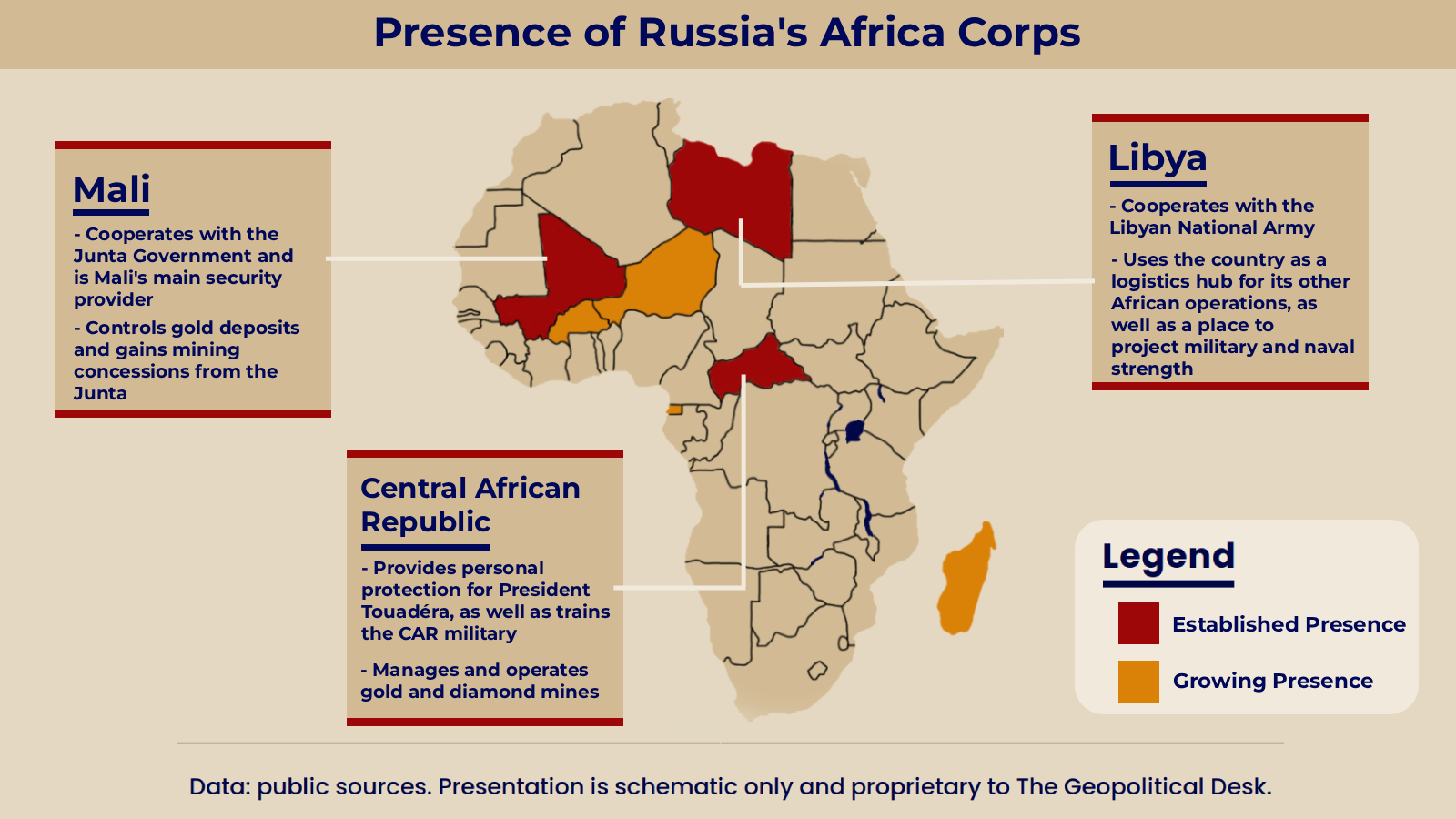
Libya
Russian presence in Libya has been publicly known and robust for almost eight years. Operating in areas under Libyan National Army (LNA) control in the centre and east of the country, Russian mercenary activities in Libya serve three main purposes: utilising the country as strategic logistical hub, assisting the LNA in deterring rival threats, and projecting power towards the EU by signalling a presence right on their southern doorstep.
