

Iran fought a war it could not win outright but could not afford to lose, and it threaded that needle remarkably well. The outcome is, by Tehran's own metrics, more than satisfying militarily, though the conflict also exposed operational ceilings and strategic shortcomings that Iranian generals will need to tackle in case of renewed conflict.
The last stand that never happened
The conflict U.S. planners and pro-war analysts expected was a linear escalation ladder: Iran under mounting pressure, would burn through stockpiles and make increasingly desperate moves until they became exhausted and capitulated.
What unfolded instead was a non-linear attrition system, an ebb and flow of escalation abated by retaliatory logic, calibration, and restraint. The conflict remained volatile, but Iran proved more resilient than expected and control over the escalation ladder allowed it to survive the conflict without resorting to a catastrophic last stand.
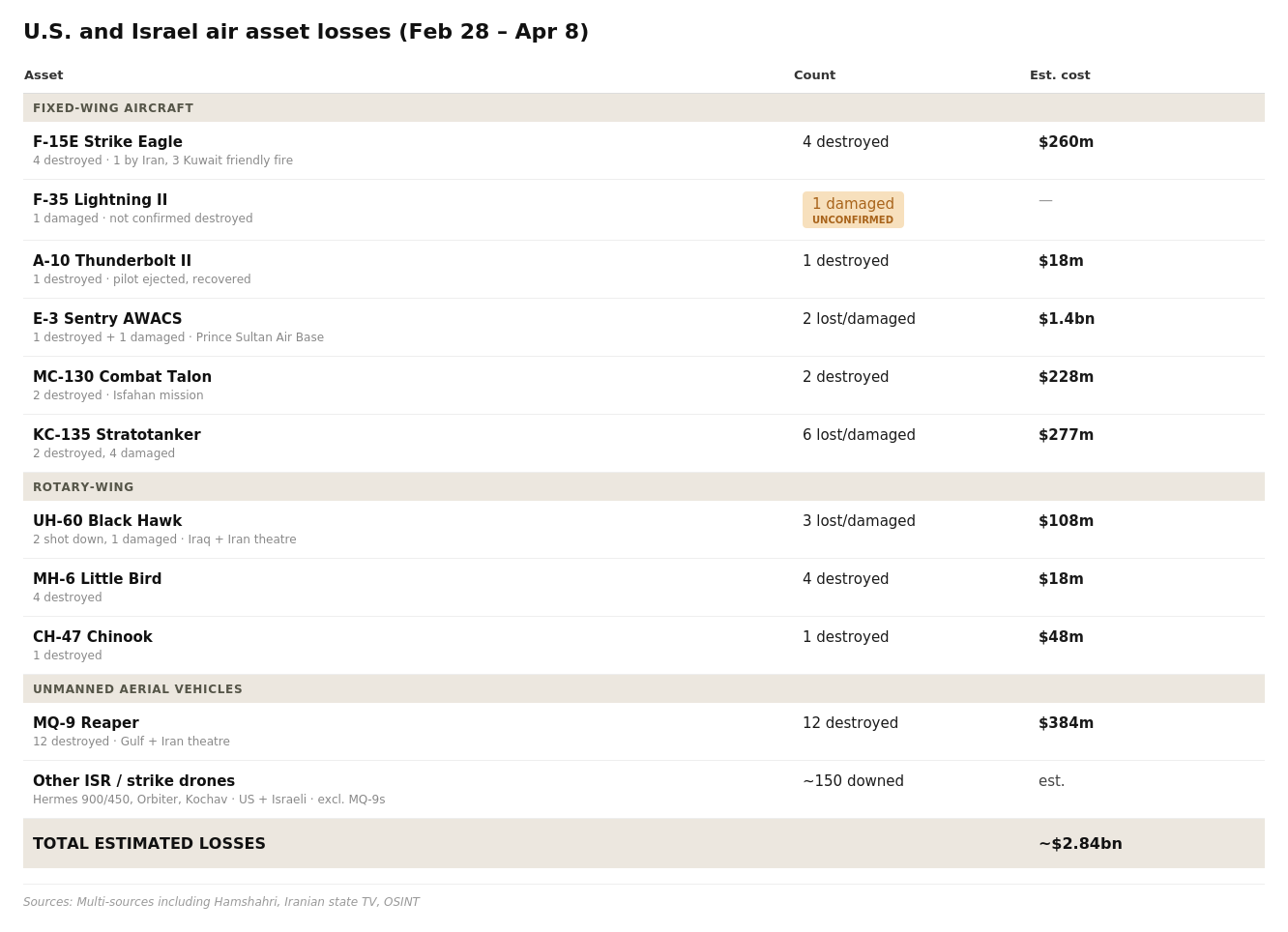
Given resilience on both sides, the war ultimately proved to be a mutual failure of shock doctrines: the United States and Israel conducted more than 20,000 combined strikes on Iran and could not break it, while Iran launched thousands of drones and missiles inflicting billions in damage on American military infrastructure, without landing the knockout blow it had propagandised.
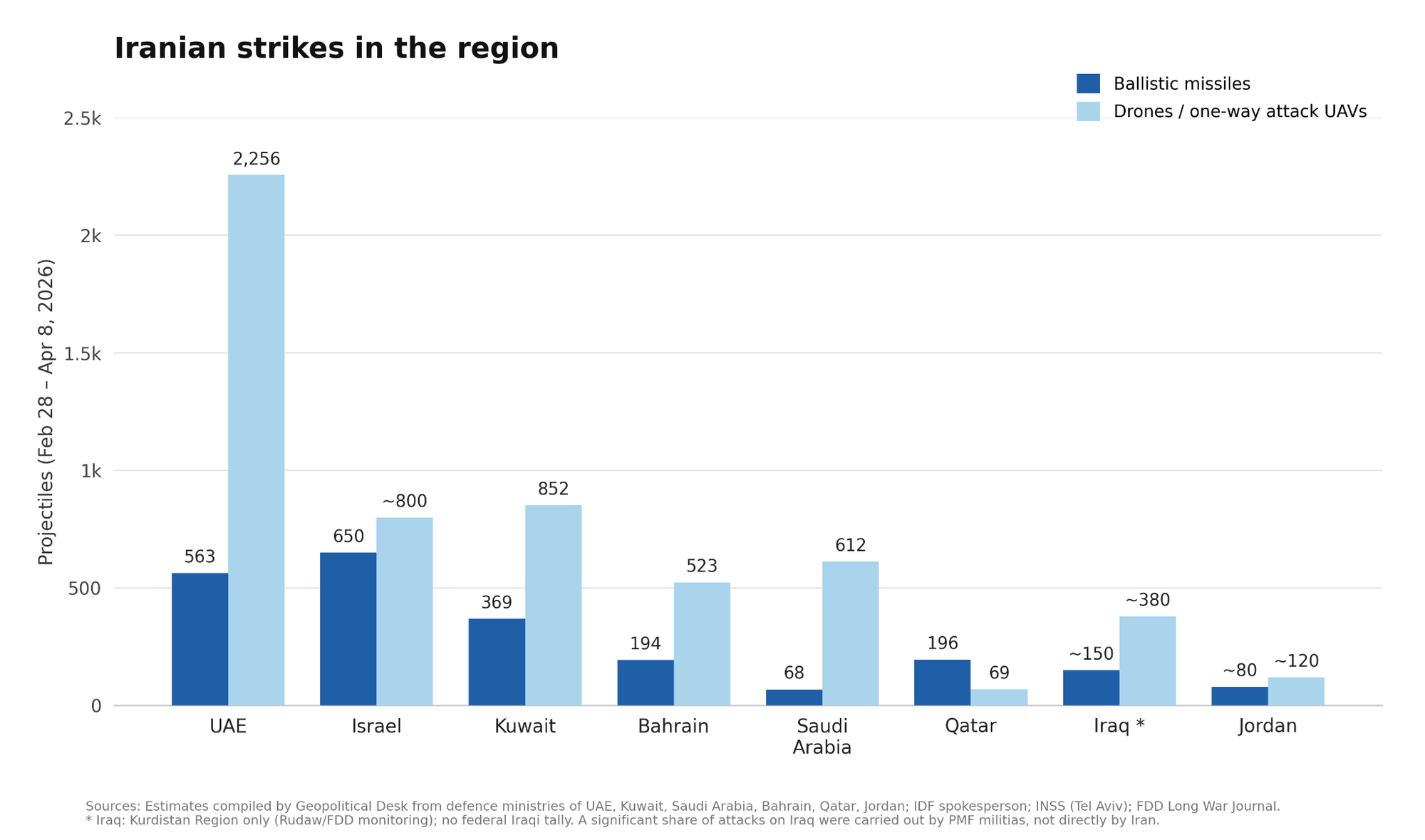
On February 28, Iran was caught off guard by high-level political decapitation, which unleashed a shock doctrine response, with Tehran jumping through escalation-ladder steps during the first two weeks of conflict.
It targeted Gulf energy and logistics infrastructure before its own energy infrastructure was hit, when Israel struck Tehran's oil storage facilities on March 7-8. Iran lashed out largely indiscriminately, even striking Oman's Duqm port despite Muscat's valuable diplomatic role in prior talks with the U.S..
Even if it denied its own responsibility, Tehran's goal was to demonstrate its ability to reach across the region's most sensitive nodes, and it even attempted to target American soldiers sheltering in hotels in high-density urban areas like Dubai.
However, this doctrine came with high political costs for Iran and immediately sparked internal debates, with the government reminding military figures that shock tactics were harming Iran’s international standing by turning it into a sheer aggressor.
Instead of creating overwhelming panic among GCC states and causing an immediate ceasefire, Iran’s shock doctrine proved counterproductive by solidifying Gulf states’ resilience and aligning their interests more closely with the U.S. and Israel.
Moreover, Iran's opponents quickly regained the escalation initiative, with Israel spearheading significant strikes on Iranian energy facilities and showing appetite for major escalation, calculating that a regionally debilitating war against Iran could draw in even more partners, Gulf states chief among them, and ensure the Islamic Republic's fall.
Although this thinking ran against U.S. interests in regional stability, Washington's threats against Iran's civilian infrastructure further raised stakes and pressure on Iran.
In response to these challenges, Tehran shifted from a campaign of demonstration to a strictly retaliatory posture, not only seeking to restore its legitimacy as a state under attack, but also pursuing a capped version of escalate-to-de-escalate: matching strikes roughly in scale and value while signaling a far harsher response in case of any repeat.
Although fragile and constantly on the brink of collapse, the war eventually found an escalation ceiling that ultimately held, with the U.S. threat against civilian infrastructure ultimately proving to be a bluff that nonetheless helped shape that ceiling.
What Iran got right
Iran's strike campaign consistently exceeded Western pre-war estimates in scale, sophistication, and durability. Underground missile cities, its most important strategic investment, kept assets buried and safe from bunker buster shelling.
That durability allowed Tehran to fight on its own clock: having prepared for a multi-month conflict, the IRGC's large opening salvoes were quickly shifted to conservation mode, a transformation that initially led U.S. assessments to wrongly claim overwhelming success in slashing Iran’s launch capabilities.
The IRGC Aerospace Force also kept adjusting rather than holding a fixed posture, shifting launch positions toward harder to attack central regions like Yazd, and decentralising engagement authority to reduce earlier command vulnerabilities, all while continuing to hit targets across eight countries.
What worked for Iran:
Asymmetric naval warfare
Iran's conventional navy, whose destruction Trump has touted as a major triumph, was never the platform Tehran relied on to contest the U.S. Navy. Shore-based underground missile and drone sites sustained maritime operations from land, while fast, missile-equipped speedboats provided maritime presence and vessel-interdiction capability.
Outcome: The vessels lost were Iran's larger surface ships, representing less than ten percent of its total naval arsenal. These losses were real but not strategically decisive: Tehran retained its strike capability against Gulf shipping throughout the conflict, preserving significant, if not absolute, control over the Strait of Hormuz.
Sustained strike capacity from underground bases
Western assessments expected Iran's missile and drone arsenal to run dry under sustained bombardment. That assumption did not hold. Some underground facilities allow direct launches from within, while others shelter mobile launchers that surface unpredictably to fire before retreating underground.
Hardening against bunker-busting munitions let large-scale missile storage and low-level manufacturing continue even during active strikes.
Outcome: The arsenal did deplete and launches did slow under pressure, but it never ran dry. Iran sustained dozens of launches daily for 40 days by carefully managing a large pre-war stockpile, mixing older and newer munitions rather than depleting its most capable systems first, denying the U.S. and Israel a clean way to strangle the campaign at its source.
Air defence performance
Israeli and U.S. planners expected to establish uncontested airspace over Iran. Mobile, dispersed air defence platforms using guerrilla tactics, surfacing and disappearing unpredictably, denied that assumption.
Domestic short-range systems such as MAJID and Azarakhsh used passive infrared detection to occasionally identify stealth aircraft while remaining resistant to jamming.
Outcome: Iran's air defence performed relatively well against the drone fleet throughout the conflict and occasionally complicated fighter jet operations, reducing IAF sorties over time rather than allowing free passage.
Precision-mass targeting
Sceptics argued Iran's strikes were failing to hit anything of real value. The pattern undercuts that claim: Iran first targeted U.S. early warning radars to blind their layered defences, then exploited that opening with a precision-mass approach, dozens of cheap, precise-enough munitions fired daily.
Outcome: 100 IRGC and 60+ Army statements documented daily salvoes against U.S. bases, and Iran's claims, once dismissed as boastful and unverifiable, were increasingly corroborated by satellite imagery and irrefutable footage, most strikingly of downed U.S. aircraft in Isfahan, turning battlefield results into a deterrent in their own right.
No domestic front
Israeli planners expected the war to trigger uprisings, particularly in Kurdistan, and to expose the regime to internal collapse more broadly. Neither materialized.
Heavy security presence and pressure on the KRG kept Kurdistan quiet, while internally, networks capable of supporting CIA-Mossad operations were painstakingly removed following the 12-day war of 2025 and the January 2026 protests.
Wartime checkpoints, mass arrests, and a sustained pro-regime presence in the streets reinforced the domestic security front.
Outcome: No domestic front opened, denying adversaries the multi-front pressure they had anticipated and removing a pathway to the kind of domestic unrest that could have forced Tehran's hand.
Pragmatic leadership over maximalism
Foreign assessments often assumed Iran's posture would be dictated by hardliners and ideological maximalism, the older generation seeking martyrdom over success. Instead, a pragmatic, tactically minded cohort now sets the tone, favouring calculated gains over open-ended confrontation.
That approach prevailed even when challenged: hardliners pushed for prolonged escalation, betting it would elevate the regime's legitimacy and global standing, but they were overruled.
Outcome: Conservative pragmatists converted whatever military gains Iran achieved into diplomatic ones rather than risking reversal by pushing for uncertain escalation and prolonged conflict.
What Iran could not convert
Iranian commanders entered the war with explicit ambitions: sink or visibly damage U.S. naval assets, produce footage of captured pilots and burning fighter jets, and fundamentally redefine regional perceptions of American military invincibility. None of this happened, and where Iran raised claims, it failed to show proof.
Operational Shortcomings
U.S. naval power untouched
Several missile operations were claimed against the U.S. Navy, including in the Gulf of Oman and northern Indian Ocean, but no visual proof emerged, unlike Isfahan, where footage made the strike strategically meaningful.
Aircraft carriers, operating hundreds of kilometres offshore and backed by escort warships, proved an effectively impossible target, their value reinforced by Iran's own success limiting regional airbase use. By keeping its navy far offshore, the U.S. denied Iran any chance to sink or damage a major American warship, while continuing to strike Iran from a range its anti-ship missiles could not accurately reach.
Energy shock fell short of scale (oil barrel never reached $200)
Disabling Gulf energy infrastructure at an overwhelming, market-moving level requires sequencing, volume, and precision Iran has not yet demonstrated. The Ras Laffan refinery strike in Qatar was a real exception, but most damage elsewhere was repaired fairly quickly by world-class Gulf repair capacity.
Moreover, Iran's understanding of global energy markets proved outdated and underestimated alternative supply sources and demand elasticity.
Hits landed, damage capped
Drones get through defences but their roughly fifty-kilogram payload limits the damage any single strike can inflict, while missiles, topping out at roughly two tonnes of explosives, face higher interception rates and still need precision improvements.
Targets are widely dispersed, and launchers operating under active pursuit by stealth fighters face severe restrictions on how many systems can be deployed at once. Iran's launches caused real damage, but it has not yet shown it can take out an entire base or energy facility in one go.
These are capability ceilings, not choices, unlike Iran's strategic limits, which reflect capacity it likely has but chose not to use, to protect its diplomatic legitimacy and avoid inviting retaliation against its own infrastructure.
Strategic constraints
After recalibrating early in the war, Tehran maintained, through extensive public messaging, that it followed a strict tit-for-tat logic, an easy case to make against Israel. That narrative was harder to sustain in the Gulf, where Iran claimed it struck only targets linked to U.S. corporate ownership, a claim that was widely contested.
Universities show where Iran had to draw the line: after Iranian campuses were targeted, Tehran threatened to hit American universities in the Gulf but never did, caught between wanting the U.S. to pay and the optics of striking civilian targets. As aforementioned, a genuine shock campaign would have turned Iran from a state under attack into one deliberately endangering civilians and wreaking havoc on the global economy.
Attack discipline slipped multiple times, notably with strikes on Turkey, Azerbaijan, Oman, and even Diego Garcia. Each had its own operational rationale, pressuring Turkey to shut a U.S. radar base, demonstrating long-range reach with Diego Garcia, but all were brazen enough that Tehran itself would not own them, possibly the result of miscoordination under decentralised command rather than multi-party consensus within the country.
The cost was regional goodwill, lost at the worst possible moment. Rather than admit the error, the foreign ministry and IRGC pushed a "false flag" narrative that was, by most accounts, fabricated, compounding an operational failure with a credibility one. Iran's partial fix has been to lean more heavily on Iraqi-aligned armed groups for plausible deniability when targeting non-military assets, but this only spreads Iran’s responsibility rather than removing it.
Armed forces' efforts to portray strikes as retaliatory are now under scrutiny in Tehran. Calibration was sold as choice, proof Iran could escalate further but chose not to, yet restraint and weakness look identical from the outside unless you can prove which one it is, and a military that threatens an escalation it never carries out risks looking weak rather than threatening.
Iranian strategists are now asking whether calibration blunted Iran's strike force and ultimately undercut its deterrence, including its capacity to inflict regional and global economic damage, and whether the next round should favour lethality and destabilisation over the restraint that sought to preserve its legitimacy this time.
The clear lesson Iranian strategists may draw is that calibration imposes its own limits, and Iran may abandon it next time. If attacked again, or even under serious threat, Iran cannot afford a passive-reactive posture.
It would need to act at full capacity from the outset, ensuring launchers are not degraded before use and reaching for escalation dominance across a wide variety of targets. Iran's openness to a first strike has already grown, as seen on June 7, when it struck Israel over the latter's continued attacks on Lebanon.
What each side might change in the future:
| Iran's potential adjustments | U.S.'s potential adjustments |
|---|---|
| Full capacity from the outset, no passive-reactive posture | Hardened, bunkered structures replacing the soft bases that took the brunt during Ramadan war |
| Wider range of targets, willingness to increase lethality | More interceptors, including low-cost solutions, and additional defence layers, including laser/energy weapons |
| Acquire or unveil anti-ship missiles capable of reaching U.S. warships at their new standoff distance, plus media access to document any hit | Greater reliance on naval power as a highly mobile, defensible strike force against Iran |
| Greater reliance on Iraqi-aligned armed groups for plausible deniability, reinforcing Hezbollah and maintaining Houthis on high alert | Focus on Arab diplomatic initiatives to ensure Baghdad and Beirut act to diminish Iranian influence in their country, while supporting Saudi-Houthi backchannels to minimise risk of Yemen turning into new front |
Why both sides paused
The war stopped because both sides reached a common escalation ceiling: a fight over energy and economic infrastructure that would have devastated the region, with neither side willing to cross that line.
Israel showed more appetite for that outcome than the U.S., with its GCC allies wanting it even less, and that asymmetry is itself a form of Iranian leverage that survives the ceasefire. The same ceiling held for water infrastructure and the upstream energy sector, where both sides caused real damage but stopped well short of the destruction that would have made the war disastrous for everyone.
The material balance reinforced that ceiling. A second round would have begun with depleted U.S.-Israeli interceptor inventories facing a still-substantial Iranian arsenal: roughly two-thirds of Iran's missile launchers are assessed as intact, Iran retains the ability to disrupt Gulf traffic, and underground manufacturing facilities alongside northeastern factories, harder to reach given distance and terrain, are largely untouched.
The U.S. could still strike Iran whenever it chose, JASSMs and comparable munitions saw to that, but every interceptor spent absorbing Iranian retaliation was one it could not recover quickly, and burning through that inventory made little sense for a war that promised no clean resolution, a cost already reflected in the Pentagon's $80 billion ask to Congress to cover the war's bill alongside other military spending.
The ceasefire wasn’t so much about exhaustion, but rather political realism. The Islamic Republic is no longer the mobilisation machine of the 1980s; its leadership has aged into pragmatism, and the population it governs cannot absorb destruction and destitution indefinitely.
Washington's calculus pointed to the same outcome by a different route: deep economic and political ties to the Gulf meant keeping energy flowing and the region stable mattered more than maximising damage on Iran, regardless of what its arsenal could still do.
Where they might restart
If war resumes within a few months, Iranian military thinking anticipates a shorter but far higher-intensity conflict, with Iran likely to move immediately against critical energy infrastructure and forcing a GCC retaliation dynamic that reproduces the same checkmate at a far greater destructive cost.
This is because Iran’s lesson would have been that it did not cause enough pain for the U.S., and regional countries, to ensure that diplomacy prevails.
If we are in for a medium to long-term peaceful period, around 6 months or more, then a new round of conflict is unlikely to differ too much from the precedent, with Iran having to once again deplete its adversaries’ interceptors, take down radars, and once more demonstrate survivability.
If the U.S. learns the lessons of this war and adapts, Iranian generals will have an even harder time to reach their stated goal. This is also a question of whether a next U.S. offensive would have a higher pain threshold, in terms of damage to Gulf countries and to its own troops.
In this unlikely situation where the air campaign shifts into troop deployments, there still are plenty of signs that this shift would prove disastrous. One only needs to look at Hezbollah’s latest campaign against Israel, in which has adapted its tactics substantially, deploying fibre-optic FPV drones with night vision capability that are undetectable and effective against both soldiers and armoured systems including Iron Dome units and Merkava tanks, drawing directly on lessons from the Russia-Ukraine conflict. Tehran would easily apply this on U.S. troops inside its territory.
As such, a next round involving the U.S. is unlikely, at least to the level experienced in the Ramadan war. Israel is likely to be the only belligerent in a future war, which would prove beneficial for the region as Iran would have much less excuse to hit GCC infrastructure and would be forced to fight like during the 12-days war.
Iranian generals may claim that their doctrine has changed and any Israeli attack will lead to Iranian strikes on U.S. interests, but the pragmatist strand ruling Tehran knows that such action would prove to be overreach and are likely to avoid this.
Finally, Iran's ultimate goal, pushing the U.S. out of the region, may be something of a poisoned gift. A U.S. with fewer bases would still strike, just differently, leaning on naval power and long-range weapons instead.
That leaves Iran with fewer targets to hit back at, not more freedom to act, since the closeness that makes its threats credible today would shrink while the threat itself stays. Losing American bases isn't automatically a win if it also takes away the targets Iran needs to make retaliation believable, especially with no real answer yet to U.S. carriers and long-range bombers.


