

Parallel to the operation "Deter Aggression" launched on November 27th 2024, Ahmed al-Sharaa — back then known as Abu Muhammad al-Jolani — began a geopolitical match that few believed winnable.
The rebel commander was facing a defiant world: Bashar al-Assad himself was slowly being reabsorbed into Arab diplomacy — handshakes in Gulf capitals, shy overtures from Europeans, even Erdogan flirted with reconciliation.
Al-Sharaa entered the arena with no openly recognised allies — and a Turkey initially fearful of “Deter Aggression" and the prospect of a new refugee wave, yet quick to move and claim the dividends of the rebels’ victory.
On November 27th, to the UN Security Council and to all capitals, Hayat Tahrir al-Sham (HTS) was a terrorist organisation. Arab media made the framing explicit — “terrorist groups” for Al-Arabiya, “armed groups” for Al-Jazeera, were launching the attack on Aleppo. Semantics diverged; judgment did not.
Upon unexpected full victory on December 8, al-Sharaa was inheriting not a state but a wreckage: sanctions-strangled, institutionally fractured and territorially dislocated. Most leaders in such conditions would pause and consolidate, but al-Sharaa moved first.
Opening moves: de-escalate, signal, reframe
Within hours of the beginning of the 10 days offensive, al-Sharaa executed a dual-track messaging campaign: private backchannels and public signals directed particularly toward Russia and Iraq, assuring no revolutionary export, no revenge purge, no regional conflagration, a readiness to open a blank page.
On the night Damascus was taken, al-Sharaa delivered reassuring remarks regarding Israel as he entered the Umayyad Mosque. A conversation meant to remain private was deliberately circulated on social media.
Upon victory, rather than turning toward HTS’ long-standing foreign sympathisers — Qatar and Turkey — al-Sharaa rewrote the script.
His first interview was not with Qatar’s Al-Jazeera, but Saudi Arabia’s Al-Arabiya.
His first foreign trip was not to Ankara or Doha, but to Riyadh, followed by the UAE — the two capitals that had previously championed Assad’s reintegration and led the Arab anti-Islamist campaign.
This was not a misstep in protocol. It was a calculated opening move.
Managing Egypt's fear of ideological spillover
Cairo saw Sharaa as a destabilising Islamist wave, and Egyptian media spent months attacking the new Syrian authorities.
What happened instead was strategic insulation: foreign Egyptian militants attempting anti-Sisi mobilisation from Syria were arrested by Syrian authorities, provocations ignored and tension diffused.
The message to neighbours was unmistakable: stability over zeal, restraint over triumph.
Saudi Arabia as the pivotal sponsor
If one capital rebalanced the chessboard, it was Riyadh. Crown Prince Mohammed bin Salman recognised an opportunity: to sever the Iranian “Shia crescent”, cut the land corridor to Lebanon, weaken Hezbollah’s logistical artery, and secure a reliable partner against Captagon networks that Assad had empowered rather than restrained.
The new Syrian leader delivered where Assad never did. Within weeks, an anti-Captagon campaign was launched, symbolising a clean break with a narco-state legacy. Saudi support was reinforced with Turkish backing, and with both emerged a shared goal: U.S. sanctions relief.
Trump’s visit to Riyadh in May 2025 marked the first decisive American shift. It was there, in a choice of words unusually emotional for U.S. policy language and one that resonated deeply across Syria and the wider Arab world, that Trump announced Washington’s intention to lift sanctions to “give Syria a chance at greatness”.
Early Biden-era caution gave way under regional pressure, yet implementation remained slow: it took seven months of American administration and regional pressures before sanctions relief became realistically achievable, still dependent on a congressional vote expected in late 2025.
Then came Washington’s decisive move.
When the U.S. placed a masterpiece on the board
The appointment of Tom Barrack as U.S. Special Envoy to Syria signalled seriousness. As Ambassador to Turkey and businessman-diplomat who is close to Trump, Barrack arrived with a broad portfolio and a strong mandate to negotiate:
- shuttle diplomacy with Israel, engaging Netanyahu and his administration through direct channels;
- talks with the Kurdish-led Syrian Democratic Forces, pressuring them to integrate into the Syrian army, as France withdraws from influence;
- pushing forward a U.S.-Qatar-Turkey investment consortium worth billions, including power grid and airport projects.
The symbolism mattered too: Sharaa in the Oval Office in November 2025, the first Syrian president ever to stand there.
The discussions regarding a possible U.S. military presence at Mezzeh airport, located in Damascus, unsettled two longtime actors: the SDF, who fear being replaced as Washington’s preferred counterterrorism partner, and Israel, uncertain how far this new Syrian-American engagement might go, which could restrict Israel's ability to act militarily in Syria.
Israel's hostility, signals and contradictions
Unexpectedly, al-Sharaa had multiplied gestures toward Israel since the conquest of Damascus — none reciprocated, but all deliberate. Returning the remains of Mossad agent Eli Cohen, without concessions and during ongoing Israeli strikes, was a message of long-term patience rather than transactional gain.
Yet Israel’s strike campaign has generated strategic contradictions. Rather than reducing any real threat to Israel — virtually nonexistent given the obsolescence of Syria’s remaining Soviet-era hardware — the bombings have instead weakened Damascus internally, eroding its capacity to contain centrifugal forces and emerging security risks.
The impact is not external deterrence, but domestic vulnerability: a state struggling to hold balance between a simmering Alawite insurgency, Suwayda’s pro-Hijri Druze separatist pressures (backed by Israel), the persistent Islamic State threat, and the delicate power equilibrium with the SDF.
Suwayda illustrates the paradox most clearly. Israel’s posture there has been marked by mixed signaling.
 The Geopolitical Desk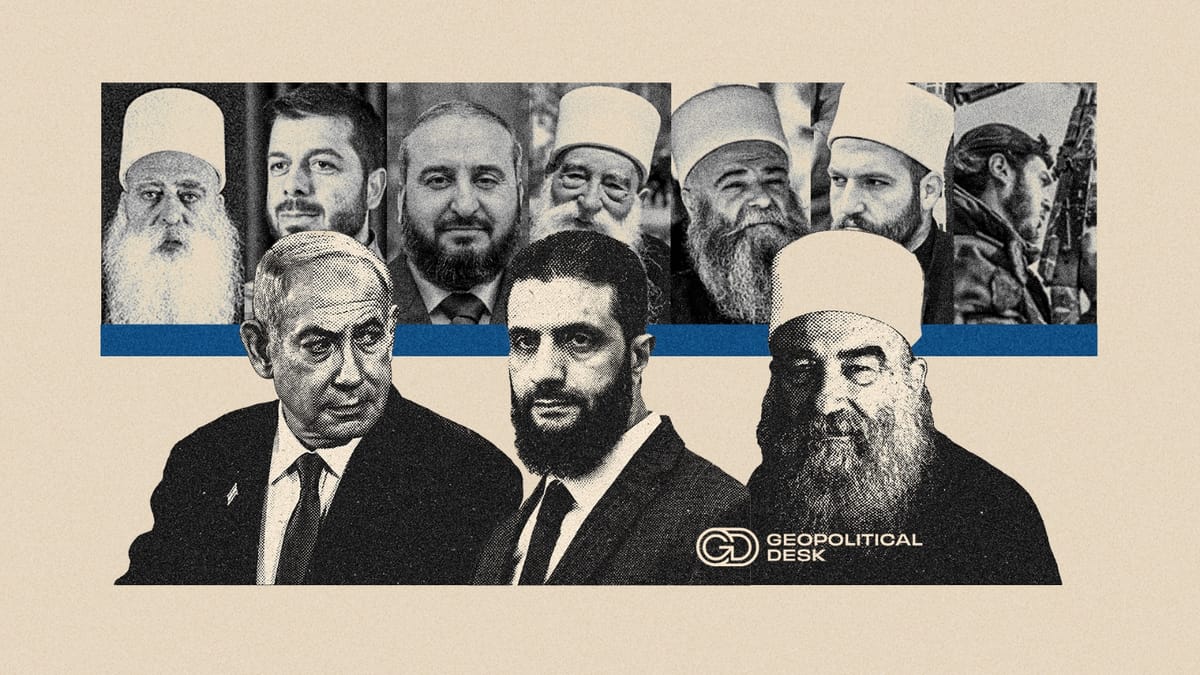
On the one hand, Tel Aviv appeared strongly aligned with Hikmat al-Hijri and the Druze militias opposing Damascus, and Israeli strikes repeatedly targeted the advancing Syrian army in the province during the failed July Syrian campaign in Suwayda.
But simultaneously, Israel used messaging through Muwafaq Tarif, spiritual leader of the Israeli Druze, urging Syrian Druze factions to eventually integrate into the new Syrian state rather than pursue secession. Two contradictory impulses — containment and accommodation — revealed a strategic indecision and short-term policy, rather than a defined strategy.
Operational geography further complicates Israel’s calculus. Between the Golan Heights and Suwayda lies Daraa — a Sunni tribal belt that remains politically hostile to Israeli entry and militarily difficult to penetrate. This buffer zone restricts Israel’s ability to shape outcomes on the ground, and limits direct support to Druze factions.
It also prevented Tel Aviv from capitalising on al-Sharaa’s early vulnerability. When Israeli strikes intensified during the Syrian army’s entry into Suwayda, they collided with tribal mobilisation and terrain that Israel could not safely traverse — pushing the province to the edge of a broader conflagration.
Israel now faces a strategic paradox:
It continues to demand a demilitarised southern zone — no heavy Syrian military assets deployed near the Golan frontier and in Daraa — yet Israeli strategy in practice has generated unintended consequences and reduced Damascus’ ability to manage domestic crises.
Weakening the centre risks empowering the periphery against Israel’s interest: Druze-linked arms trafficking networks — some of which now channel weapons into Israel itself — and a grassroots Sunni insurgency in Daraa (which led to several deadly confrontations against the Israeli army). Both thrive in precisely the power vacuum airstrikes and irrealistic demands are creating.
Washington’s pressures, as shown by Trump’s declaration on November 1st, combined with the Syrian leadership’s deliberate restraint toward both Druze and Kurds, presently constrains Israel’s escalation options. The Syria file in Tel Aviv is not resolved but suspended — an unresolved dilemma held in stasis, not settlement.
